
Can Flat Feet Cause Back Pain?
- footporium
- Jul 9
- 6 min read

A sore lower back does not always start in the back. If your arches collapse when you walk or stand, the change in foot position can travel upwards through the ankles, knees, hips and pelvis. That is why patients often ask, can flat feet cause back pain? In some cases, yes - but the relationship is not always straightforward.
Flat feet, also called fallen arches, are common. Some people have had them since childhood and never experience any symptoms. Others develop them over time and notice aching feet, tired legs, knee pain or a back that feels worse after long periods on their feet. The key question is not simply whether the arch looks low. It is whether the way the foot functions is placing extra strain on the rest of the body.
Can flat feet cause back pain through foot mechanics?
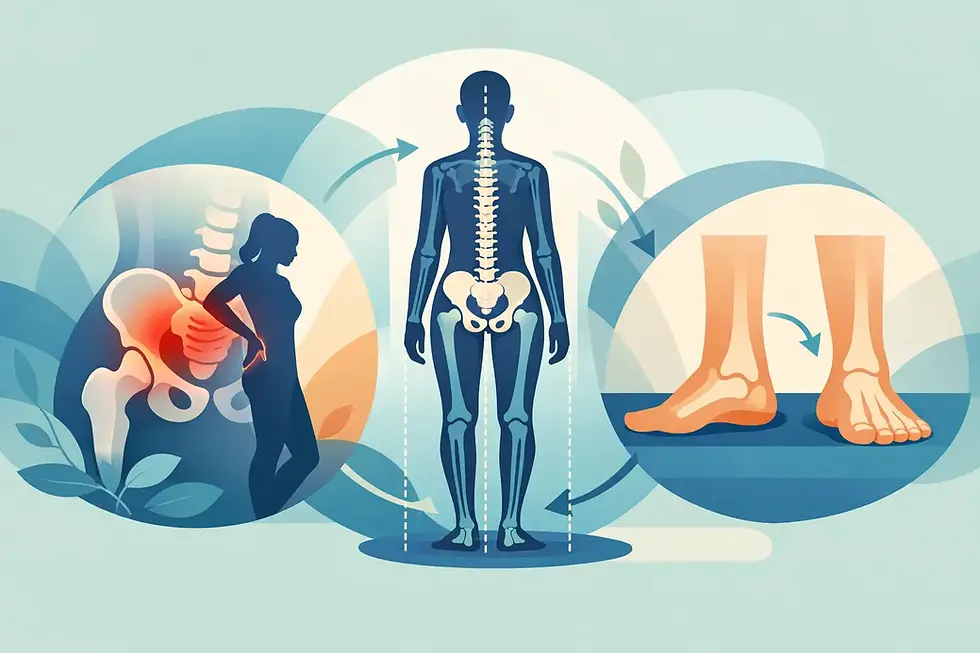
They can. The foot is the base of the body's support system, so when its alignment changes, the structures above it often have to adapt. In a flat foot, the arch may drop and the foot may roll inwards more than it should. This movement, known as overpronation, can alter leg rotation and affect how the pelvis sits during standing and walking.
For some people, that altered movement pattern increases stress through the lower back. Muscles may work harder to stabilise the pelvis, joints may be loaded unevenly, and symptoms can build gradually rather than appearing after one clear injury. It is particularly common in people who spend long hours standing, walk long distances for work, or take part in running and field sports.
That said, not everyone with flat feet will get back pain. Many people have low arches but excellent strength, good mobility and no discomfort at all. Others may have back pain mainly due to disc problems, arthritis, poor load tolerance, pregnancy, deconditioning or prolonged sitting, with the feet playing only a small part. This is why assessment matters.
How the chain from foot to back works
The body does not move in isolated sections. When the foot rolls in excessively, the shin may rotate inwards more than expected. That can influence knee position, which can then change how the hip moves. If the hip and pelvis are no longer moving efficiently, the lower back may compensate.
This does not mean a flat foot directly "causes" every episode of back pain. It means it can be a contributing factor in the kinetic chain. In clinical practice, we often see this in patients who describe a combination of symptoms rather than just one painful area. They may report aching arches, tired calves, knee discomfort on stairs, tight hips and a lower back that flares after walking or standing.
The pattern can be even clearer when one foot is more affected than the other. An uneven foot posture may create an asymmetry that leads to one side of the pelvis being loaded differently. Over time, that can feed into one-sided low back pain or a feeling that one hip is always tighter than the other.
What back pain linked to flat feet often feels like
When flat feet are part of the problem, the back pain is often mechanical. That means it tends to change with movement, posture or activity rather than being constant day and night. People commonly notice stiffness first thing in the morning, aching after a long shift, or soreness that appears after exercise rather than during it.
You may also notice that the back pain comes with foot fatigue, ankle rolling, knee discomfort or pain that worsens in unsupportive shoes. Some patients say they feel better in structured trainers and worse in soft, worn-out footwear. Others notice their symptoms when walking barefoot on hard floors at home.
The absence of foot pain does not rule this out. A person can have flat feet that affect overall alignment without their feet being the main site of symptoms. In those cases, the lower back, hips or knees may be what brings them in for assessment.
When the problem is more than just low arches
A low arch on its own is not a diagnosis. What matters is whether the foot is flexible or rigid, whether the arch drops only under load, whether there is tendon strain, and how the rest of the lower limb behaves during walking.
For example, posterior tibial tendon dysfunction can lead to a progressive flattening of the foot in adults and may come with inner ankle pain and increasing difficulty walking. A stiff flat foot may behave differently from a flexible flat foot and may need a different treatment approach. Equally, tight calf muscles, weakness around the hips, joint hypermobility or a leg length difference can all make the picture more complicated.
This is one reason self-diagnosing from the appearance of the arch can be misleading. Two people can both describe themselves as flat-footed, yet one may need very little treatment while the other benefits from a full biomechanical assessment and a targeted management plan.
Can flat feet cause back pain in children and teenagers?
Sometimes, but caution is needed. Flat feet are very common in children, especially when they are younger, and many develop perfectly normal arches over time. A child with flat feet does not automatically need treatment, and many have no pain at all.
However, if a child or teenager is experiencing foot pain, tiring quickly, tripping more than expected, avoiding sport, or complaining of knee, hip or back discomfort, it is sensible to have things assessed. The aim is not to label every flat foot as a problem. It is to work out whether the foot posture is affecting function, comfort or development.
What assessment should look at
If back pain may be linked to flat feet, a useful assessment goes beyond a quick glance at the soles of the feet. It should consider how you stand, how you walk, how each joint moves, where you are tender, and how symptoms behave during daily activity.
A podiatric biomechanics assessment may look at foot posture, ankle range of motion, calf tightness, limb alignment, hip control and gait pattern. Footwear is also relevant. Shoes that are too soft, too worn or poorly fitted can allow unstable mechanics to continue. In some cases, the clinician may also advise that another professional, such as a physiotherapist or GP, should be involved if the symptoms suggest a broader spinal or muscular issue.
This joined-up approach is important because back pain is rarely caused by one factor alone. Often it is the combination of foot mechanics, activity levels, strength deficits and load exposure that leads to symptoms.
Treatment if flat feet are contributing to back pain
Treatment depends on what the assessment finds. For some people, simple changes are enough. Better footwear, activity modification and exercises to improve strength and control can reduce the strain travelling up the chain.
In other cases, orthotic intervention may be appropriate. Insoles do not "fix" flat feet in a cosmetic sense, but they can improve how forces are distributed through the foot and lower limb. That can help reduce excessive pronation, improve comfort and ease the stress contributing to pain higher up. Custom orthoses are usually most useful when they are based on a proper clinical assessment rather than chosen off the shelf at random.
Exercises can also play an important role. Depending on the presentation, treatment may include work for the intrinsic foot muscles, calf flexibility, ankle control, gluteal strength and pelvic stability. If the back has become sensitised because it has been compensating for months, addressing the foot alone may not be enough. The best outcomes often come when the whole movement pattern is considered.
When to seek professional advice
If your back pain keeps returning, especially alongside foot, ankle, knee or hip symptoms, it is worth looking at whether biomechanics are involved. The same applies if you know you have flat feet and feel that standing, walking or exercise is becoming harder to manage.
You should seek prompt medical advice if the pain is severe, follows trauma, wakes you regularly at night, or is associated with numbness, weakness, altered bladder or bowel function, or unexplained weight loss. Those features need medical review and are not simply a flat-foot issue.
For persistent mechanical pain, a specialist podiatry assessment can help identify whether your feet are contributing and what can realistically be improved. At Footporium Podiatry, that often means looking beyond the painful area and assessing the way the whole lower limb is working, because the source of the problem is not always where you feel it.
Flat feet can cause back pain, but they do not always do so, and they are rarely the whole story. If your posture and walking pattern are placing repeated strain through the kinetic chain, the right assessment can make the picture much clearer - and help you move more comfortably with a treatment plan that addresses the cause, not just the ache.


Comments